




Kynett PHYSIO Package
- Kynett covers all import duties and taxes for US orders
- Free shipping to EU, US, UK
- 1-Year Warranty
- CE (MDR) Certified
- In stock, ready to ship
The Kynett PHYSIO Package has been developed for physiotherapy clinics that want to go beyond traditional strength training.
By using flywheel training instead of fixed weights, resistance automatically adapts to the patient’s effort. This allows precise, controlled, and progressive strength development throughout rehabilitation.
The package is configured as an ideal setup for physiotherapy practices — compact, versatile and ready for immediate clinical use.
Thanks to the included bar and accessory system, all muscle groups can be trained efficiently and safely within one integrated setup.
BENEFITS
✔ Resistance automatically adapts to the patient’s effort
✔ Integrated eccentric loading
✔ Applicable across multiple rehabilitation phases
✔ One system for training all major muscle groups
CLINICALLY APPLICABLE FOR
✔ Anterior cruciate ligament (ACL) rehabilitation
✔ Tendon-related conditions
✔ Post-operative strength development
✔ Hamstring rehabilitation
✔ Shoulder stability training
✔ Return-to-sport programs
Kynett HOME Flywheel package includes:
- Kynett HOME Flywheel
- Wall adjust HOME with glider
- 4 mm HOME Disc set (0,020 kgm2)
- Accessories included: Standard Grip, CrossFit handles, Ankle cuff, Carabiner
Product Information
- Inertia 88.7 lb.in2 (0,026 kgm2)
- Resistance 0-176 lb (0-80 kg)
- For physiotherapists and rehabilitation centers
- Resistance discs HOME 3 mm - 5 mm are compatible with the Kynett HOME Flywheel
- Weight of device: 11 lb / 4,9 kg
- Made of engineering plastics
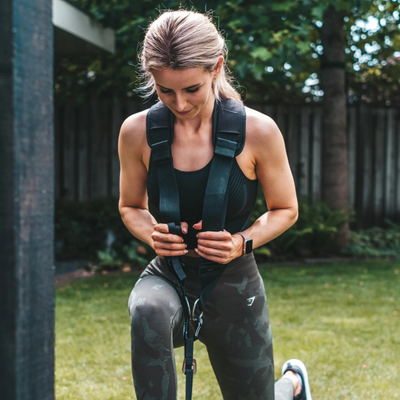
- Optional ADD-ONS: 3 mm HOME Disc Set, 5 mm HOME Disc Set, Pulley Support, Squatplate, Squatdeck, Harness, all equipment attachments

Kynett ships its products through the worldwide network of UPS & FedEx. It ensures that your order can be delivered worldwide within 2-4 business days.
Just before a shipment, the customer receives a tracking number, so that the shipment can be followed by track & trace.
Please note for customers outside the EU:
That any duties and import taxes are the responsibility of our customers. These fees are determined by the customs authorities in your country and are separate from the product's purchase price and shipping charges.
When you place an order with us, you may be required to pay duties and import taxes upon the arrival of your package. The customs authorities in your country will assess these fees based on the declared value of the items in your order and the applicable customs regulations.