




Kynett STREXBOX™ Flywheel
- Introduction Discount
- Designed to fit with all training environments
- Worldwide shipping in 5–7 business days
- Made in the EU
- Available Worldwide - Now in-stock
- In stock, ready to ship

NOW AVAILABLE!
The Kynett STREXBOX™ Flywheel is now available and ready for shipment.
This gives you early access to our newest flywheel training solution.
IN-STOCK BENEFITS
✔ 10% in-stock discount
✔ Free Bicep Tricep bar
✔ Now in stock - ships in 5-7 business days
Built and refined in the Netherlands. Every STREXBOX™ ships fully assembled, tested, and ready to train — including our latest design improvements.
The Kynett STREXBOX is a NEW compact versatile flywheel training system designed for professionals, athletes and home users.
Flywheel training is known for its ability to generate adaptive resistance and eccentric overload, making it highly effective for strength development, injury prevention, and rehabilitation.
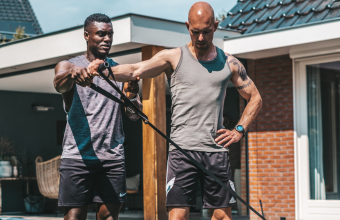
The STREXBOX brings these principles into a compact and portable system that can easily be integrated into all training environments. Flywheel training has proven benefits for strength development, injury prevention and rehabilitation. Its compact design makes the system easy to place, store, and use, while still delivering the training stimulus expected from professional flywheel resistance training.
Product Information
- Inertial Load Range: 0.038 kgm2 - 0.312 kgm2
- Resistance: 0-200+ kg
- For physiotherapists, performance centers, and home training setups
- Product Dimensions (L x W x H): 60 x 40 x 10 cm
- Weight (STREXBOX system): 9 kg
- Webbing Length: 2.5 m
- Made of high-quality EU materials
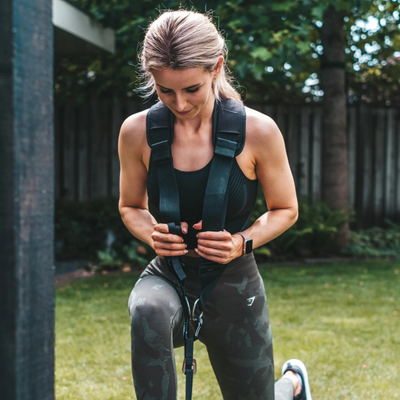
- Key benefit: Train Anywhere - No poles or anchors needed!
- Kynett STREXBOX Flywheel
- STREXBOX Disc M (0,086 kgm2)
- Harness
- Multifunction Handle
- Strap Adjust
- Carabiner
- Kynett Webbing
(2,5 meter Kynett webbing) - Manual
FREE item: Bicep-/Tricep Bar
Description STREXBOX Discs
Train with up to three STREXBOX discs on the Kynett STREXBOX and easily adjust inertia and training intensity by stacking discs!
NOTE: The STREXBOX device is compatible only with STREXBOX resistance discs.
Example: The STREXBOX Disc M provides a similar resistance level as the 15 mm Kynett disc set. This allows users to achieve a high training stimulus within a compact system!
Kynett ships its products through the worldwide network of UPS or FedEx. Just before a shipment, the customer receives a tracking number, so that the shipment can be followed by track & trace.
Please note for customers outside the EU:
That any duties and import taxes are the responsibility of our customers. These fees are determined by the customs authorities in your country and are separate from the product's purchase price and shipping charges.
When you place an order with us, you may be required to pay duties and import taxes upon the arrival of your package. The customs authorities in your country will assess these fees based on the declared value of the items in your order and the applicable customs regulations.